Most people see the finished episode. The clean audio, the sharp thumbnails, the polished clips that show up on LinkedIn. What they do not see is the lens cap that stayed on for an entire recording. Or the five episodes with no microphone audio because nobody knew the batteries had died. Or the corrupted SD card that wiped hours of sound and turned the team into accidental audio engineers overnight.
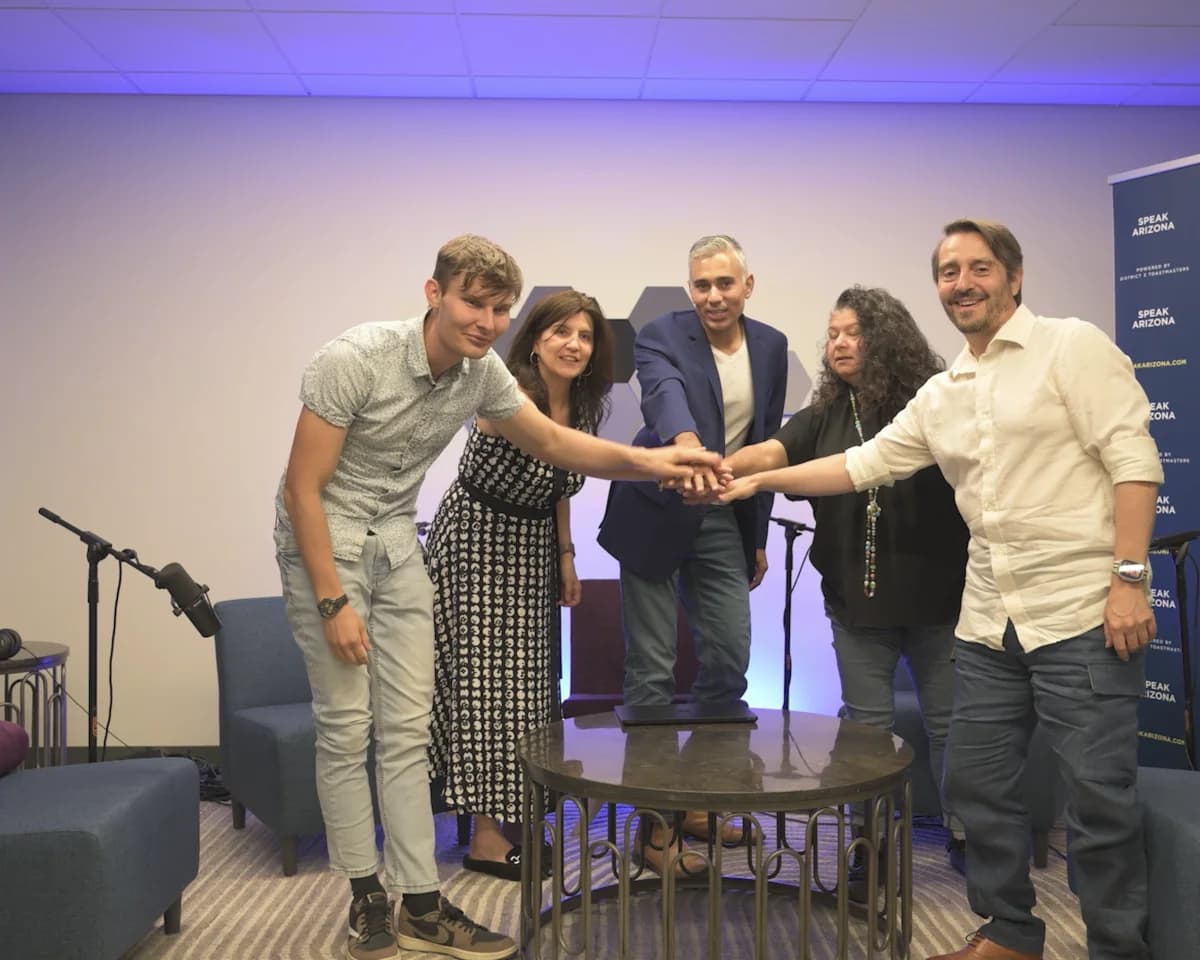
For Episode 100, the Speak Arizona team turned the cameras around. Host Rupesh Parbhoo sat down with the people who make the podcast happen behind the scenes: editor Matthew Malan, PR manager Marie Feutrier, video editor Vincent Feutrier, and social media strategist Edna. No guest expert. No polished topic. Just the raw, honest story of how a volunteer podcast went from 10 views to 10,000 and what it cost to get there.
The podcast started as a happy accident. Rupesh was invited on as a guest by Shavon Murray, who had relaunched the show in 2024. He enjoyed the conversation and stuck around. Then, one by one, the original team members moved on to new jobs and new priorities. Suddenly Rupesh was alone with a pile of unedited recordings and no idea how to use the equipment.
"The first time I came to the studio on my own, I couldn't get anything to work," Rupesh said. "I couldn't figure out a setting on the Rodecaster. It was embarrassing."
He gave himself three months. If the podcast was still a disaster by March, he would hand it off to someone else.
Matt was the first to join. He volunteered through email right after recording his own episode as a guest. Then Marie offered to help, and Rupesh did not hear it. Not the first time. Not the second time either. It took months before her offer finally registered. When it did, she showed up with a plan. She would handle the website, the social media platforms, the LinkedIn presence, all of it.
"I said, 'But Marie, who's going to do all this?' And she said, 'I am,'" Rupesh recalled.
Marie built the Speak Arizona website from scratch in a weekend. She took over public relations for the podcast and started telling the real stories of the people behind the microphone. Vincent, who had been watching Marie light up every time she talked about the podcast, wanted in too. He taught himself video editing on open-source software, spent weeks learning the tools, and eventually switched to the same platform the rest of the team was using so they could collaborate.
Edna joined most recently after seeing a call for volunteers on the District 3 Facebook page. She had been studying digital marketing and saw the podcast as a place to practice what she was learning. "You got to practice, learn it, and then now you have to apply it," she said. "This is giving me the opportunity to implement what I've been learning."
The turning point came at a backyard gathering at Rupesh's house. The team sat him down. It was less of a discussion and more of an intervention. They told him they were ready to commit, but they needed to know he was committed too. If he was going to leave in six months, all the energy they were pouring in would disappear.
"If Rupesh is not committed, it's going to be hard for us to commit as well," Vincent said.
They pledged 18 months. That promise became the foundation everything else was built on. Marie felt she could finally invest in the brand. Vincent bought a new computer because his ten-year-old laptop could not handle the video files. Matt started pushing through the steep learning curve of Adobe. The podcast had a team, and the team had a timeline.
The mistakes kept coming. Matt recorded an entire episode with the camera lens cap on. Rupesh forgot to check the microphone batteries for five straight recordings. When they finally solved the battery problem, the SD card corrupted. They spent hours trying to sync video with audio from different sources, frame by frame, without a clap to align them. They learned that SD cards have different formats and do not always work across devices. They learned that even NASA astronauts forget their SD cards.
"You either win or you learn," Matt said. It became the team's unofficial motto, texted into the group chat every time something went sideways.
The conversation kept circling back to perfectionism. Rupesh talked about the urge to go back and reformat every old episode so the titles and thumbnails matched. Vincent described spending hours getting a single zoom transition right because he wanted the viewer to feel the weight of a moment. Matt agonized over thumbnails, going back and forth between AI tools and Canva until the angles and lighting were just right.
But the team also learned when to let go. Early on, they debated whether to edit out filler words and stumbles. Matt pushed for leaving them in. "Be authentic," he said. "Leave the mistakes." Rupesh resisted at first, then came around. The episodes might not sound as polished, but they sound real.
That tension between polish and authenticity runs through everything the team does. Marie talked about the importance of showing a real face on social media rather than hiding behind stock photos. Rupesh admitted there are parts of himself he still has not shared on the podcast. He talked about the fear of putting yourself out there and the instinct to stay neutral, to not alienate anyone.
"The thing that you're afraid of sharing the most, the stutter or your vulnerability or weakness, is what people connect with you the most," he said.
(Matt knows this firsthand. Hear how he went from a childhood stutter to the contest stage, and how Jennifer Emperador told her hardest story on the DEBx stage.)
Vincent framed the whole experience as an investment. The skills they are learning on a volunteer podcast are translating directly into paid work. He and Marie landed their first professional video editing gig because of what they learned at Speak Arizona. Matt started his own podcast, Stay Hungry, focused on companies and entrepreneurs. Edna is building a social media portfolio that will carry into her career.
"Even if we're putting money, if we're putting time, we are investing first for ourselves," Vincent said. "The learning is so unbelievable."
As for what comes next, Rupesh wants to grow the podcast into a platform for small businesses and local voices across Arizona. He wants curated conversations about communication, leadership, and confidence. He wants playlists of public speaking tips drawn from 100 episodes of guest expertise. And he wants to keep capturing this moment, messy and imperfect as it is, because it will never look quite like this again.
Marie put it simply. "We will be successful when we get mean comments."
They are not quite there yet. But 100 episodes in, with a team that showed up when nobody asked them to, a brand built from scratch on a volunteer's weekend, and a growing audience that is starting to comment on the mistakes they are brave enough to leave in, Speak Arizona is no longer a side project. It is a movement finding its voice.
Connect with the Team
Rupesh Parbhoo
- LinkedIn: Rupesh Parbhoo
Matthew Malan
- LinkedIn: Matthew Malan
- Instagram: @matthewmalan8
- Website: matthewmalan.com
Marie Feutrier
- LinkedIn: Marie Feutrier
- Instagram: @marie.feutrier
- Website: headshotsbymarie.com
Vincent Feutrier
- LinkedIn: Vincent Feutrier
- Instagram: @vincent_feutrier
Listen to the Full Episode
Catch the full conversation on your favorite platform:
New episodes drop every week. Subscribe so you never miss a courageous conversation.
Learn more about the Speak Arizona team →
Speak Arizona is powered by District 3 Toastmasters, serving Arizona, southern New Mexico, and West Texas. New to all this? Learn how to get better at public speaking and find a club near you.