If you made a decision to get into great physical condition, would you go to the gym, get in great shape, and then stop going?
That is the question Paul Brunoforte asks anyone who wonders why he is still in Toastmasters after 42 years. The answer is the same reason you don't cancel your gym membership after you can run a mile. The skills need maintenance. They need evolution. And there is no finish line.
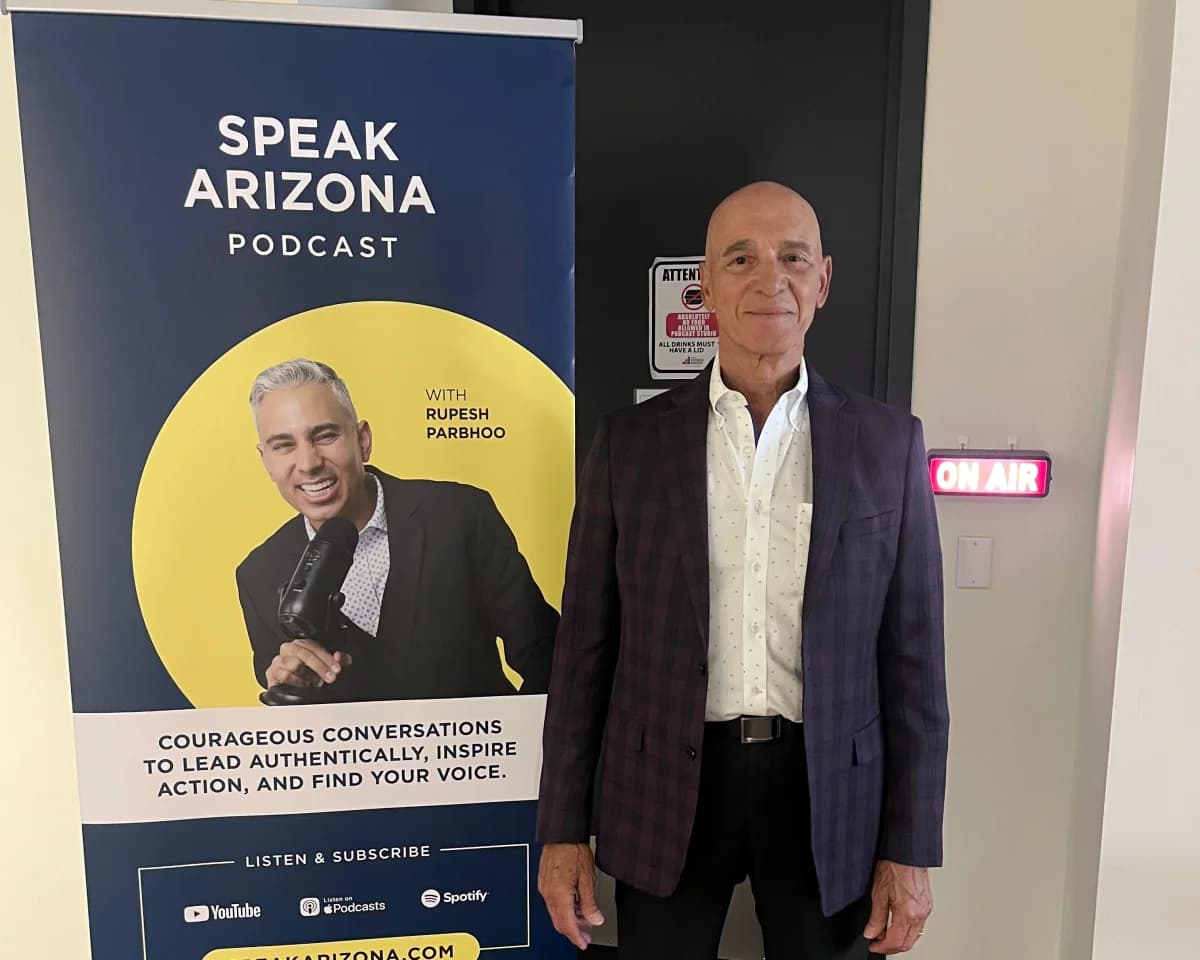
Paul is a Distinguished Toastmaster, a longtime leader of Dobson Ranch Toastmasters in Mesa, Arizona, and the founder of the Olympic Method, a coaching company built around personal development and goal setting. He is also a District 3 International Speech Contest champion who competed at the World Championship of Public Speaking in Vancouver, where he reached the semifinals and came second to the speaker who went on to win the world title. He has been teaching goal setting through Junior Achievement since 1976 and has run his American Success Story workshop for more than 40 years.
He sat down with host Rupesh Parbhoo to talk about what four decades of Toastmasters have taught him, what gets in the way of people reaching their potential, and what kind of feedback actually helps people grow.
The Evolution
Paul did not join Toastmasters to become a lifelong member. He joined because every motivational book he read during his MBA at ASU recommended it. Zig Ziglar. Earl Nightingale. They all said the same thing: if you have a great idea, it is not going to be a great idea unless it is communicated well.
He walked into his first meeting thinking he would be a star. He was not. Several of the members were so polished they could have hosted a talk show. That humbling moment was what sunk the hook.
What kept him was the evolution. His first decade was focused on professional presentations and business speaking. Then someone challenged him to try humor. Paul was a CPA. Stoic. Buttoned up. Humor was not in the plan. But the challenge pushed him outside his comfort zone, and what followed was what he calls his comedic period, years of finding the funny in himself and learning not to care what people thought.
After that came mentorship. Then leadership. Then coaching. Each decade brought a new phase, and each phase opened doors he never could have anticipated.
"So many doors open up that you can't anticipate," Paul said. "There was no way I could have foreseen some of the opportunities that actually occurred."
The Olympic Method
Paul's coaching philosophy is built on three principles borrowed from what makes Olympians extraordinary: coaching, coachability, and commitment.
Olympians are ordinary people who do extraordinary things. They all have coaches. They are all coachable. And they all have the commitment to push through the uncomfortable periods that come with growth.
Most people, Paul has found, are missing at least one of those three. They do not seek out coaches. Or they nod at feedback and never apply it. Or they hit resistance and back off.
"A lot of people hit the resistance and then they back off," Paul said. "Olympians don't do that. Olympians hit the resistance and force their way to the next level."
Being coachable, in Paul's world, is not about being polite. It is about action. When he mentors someone at Dobson Ranch, his first instruction is simple: be proactive. Every time you are assigned a role you have never done before, call me. Ask how to crush it. Walk into the meeting with the intention of performing so well that the club notices.
"If you walk into the meeting with that idea, which I always do, that transfers to the outside," he said. "You make it a habit of always doing your best."
Drop the Marble
At Dobson Ranch, when a speaker says "um" or "ah" or pauses too long, a marble gets dropped into a can. It is loud. It is immediate. And it works.
A lot of clubs have softened this over the years. Some use a quiet clicker. Some just write the count down on paper. Paul thinks that is a mistake. The marble is the feedback. If you do not hear it, you do not know you are doing it. And if you do not know, you cannot fix it.
"It's fun and it's helpful," Paul said. "Every time you hear an 'um' or an 'ah' or a pregnant pause, drop the marbles."
He extends this philosophy to a tradition that Dobson Ranch used to practice more openly: the Whitewash Award. The award was originally given when an evaluator stood up and told a speaker everything was great without offering any constructive feedback. It was called whitewashing because the evaluator had painted over the truth.
For decades, club members would nominate each other for the Whitewash Award the same way they nominated each other for the Spark Plug Award, which recognized someone who went above and beyond. Both nominations happened in the meeting. Both were public. And both served a purpose.
Over time, the Whitewash Award faded. Someone dropped out of the club after receiving one, and the discomfort around it grew. Paul believes that was a loss.
"People need to know that they underperformed," he said. "We have become so afraid of hurting people's feelings that we withhold the very feedback that they need to grow."
He is quick to point out that the feedback is not personal. It is an observation. It is a standard. And learning not to take it personally is itself a skill that transfers to the real world, where bosses are tough, relationships are challenging, and not every piece of criticism comes wrapped in kindness.
"Why not thicken your skin so that when you go out into the real world, you can handle a tough boss?" he said. "There are a lot of people whose feelings get hurt. They quit great jobs. They quit relationships because they have not learned how to deal with something that is a little uncomfortable."
The Speech That Changed Everything
For years, Paul was a technically excellent speaker. Professional. Polished. Predictable. Then someone challenged him to stretch.
So he dressed up as a sperm and gave a speech called "The Great Race" about how he was born.
It is exactly as ridiculous as it sounds.
But that speech cracked something open. Paul had stretched so far past his comfort zone that he never came back to where he was before. Humor became easy. Risk became normal. The stoic accountant had found a part of himself that 20 years of professional speaking had never touched. (Comedian and Toastmaster Paul Pastore makes the same case: funny is built, not born.)
"My big encouragement to people is stretch, take a risk," Paul said. "I want you to stretch to the point that we have to pull you back. Don't be afraid to be an idiot, because this is the experiment place."
Bad Habits and Goal Setting
Paul has been teaching goal setting for more than 40 years. He started by attending a Zig Ziglar Train the Trainer program in 1981 and brought those principles back to his employees. He has facilitated the workshop 20 to 25 times, teaches financial literacy to high schoolers through Junior Achievement, and in 2009 invested $15,000 to become a certified professional coach because he wanted to understand why only 10 to 20 percent of his seminar participants ever changed their behavior.
What he learned is that the biggest barrier to achieving goals is not a lack of ambition. It is ingrained bad habits.
"A lot of people think just by setting the goal and writing it down that it's going to automatically occur," Paul said. "Well, it doesn't."
He points to books like Charles Duhigg's "The Power of Habit" and James Clear's "Atomic Habits" as essential reading. The strategy is not to eliminate bad habits, which tend to lurk and resurface. It is to layer good habits on top of them until the good habits take over.
He also learned something else through his coaching certification: people need skin in the game. When he coached for free, retention was low. When he started charging, people paid attention. Commitment looks different when something is on the line.
Join More Than One Club
Paul's practical advice for anyone who wants to accelerate their growth is straightforward: join at least two clubs.
At Dobson Ranch, a member might give three or four speeches a year. They might be Toastmaster of the meeting once. General evaluator once. That is not enough repetition to build real skill, the same way going to the gym once a week for 90 minutes will not get you in great shape.
Paul was in three clubs during his contest years. He wanted to make sure he had multiple chances to compete, multiple audiences to speak to, and multiple opportunities to practice. He encourages every new Toastmaster to do the same after their first 60 to 90 days.
"If you like Toastmasters, find another club that works into your schedule," he said. "Join at least two clubs."
Grandparenthood at 80
When asked what had inspired him recently, Paul did not talk about a book or a podcast. He talked about his grandchildren.
He had just spent a full week babysitting his three grandkids, ages one and a half, three, and six, while his son and daughter-in-law were in Hawaii. It was the first time he had been with them for more than a few hours at a stretch. And it changed everything.
"I didn't really get grandparenthood until this week," Paul said. "Every year, I want you guys to take at least a one-week vacation where Debbie and I will babysit, because this was fabulous."
At 80, he is still finding new things to be inspired by. When he was 70, he thought 80 was old. Now that he is 80, he has decided 90 is old. He keeps pushing the decade out.
The Three Ds
Paul's formula for achieving anything worth achieving is simple enough to remember and hard enough to follow through on: delay gratification, discipline, and desire.
He reached financial independence 20 years ago. He has spoken to 8,000 people at the ASU MBA graduation without notes. He has keynoted a 600-person corporate event on a stage with jumbotrons. None of it would have happened without Toastmasters, and none of it happened overnight.
"If you would have asked me 30 years ago, I would never feel like I could do that," he said. "But with Toastmasters, your confidence grows gradually."
About Paul Brunoforte
Paul Brunoforte, MBA, DTM, is the founder of the Olympic Method and a 42-year member of Toastmasters International. He is a District 3 International Speech Contest champion who competed at the World Championship of Public Speaking in Vancouver, Canada. He has been a member and leader at Dobson Ranch Toastmasters in Mesa, Arizona, and has taught financial literacy through Junior Achievement since 1976. Connect with Paul on LinkedIn.
Listen to the Full Episode
Catch the full conversation on your favorite platform:
New episodes drop every week. Subscribe so you never miss a courageous conversation.
Learn more about the Speak Arizona team →
Speak Arizona is powered by District 3 Toastmasters, serving Arizona, southern New Mexico, and West Texas. New to all this? Learn how to get better at public speaking and find a club near you.