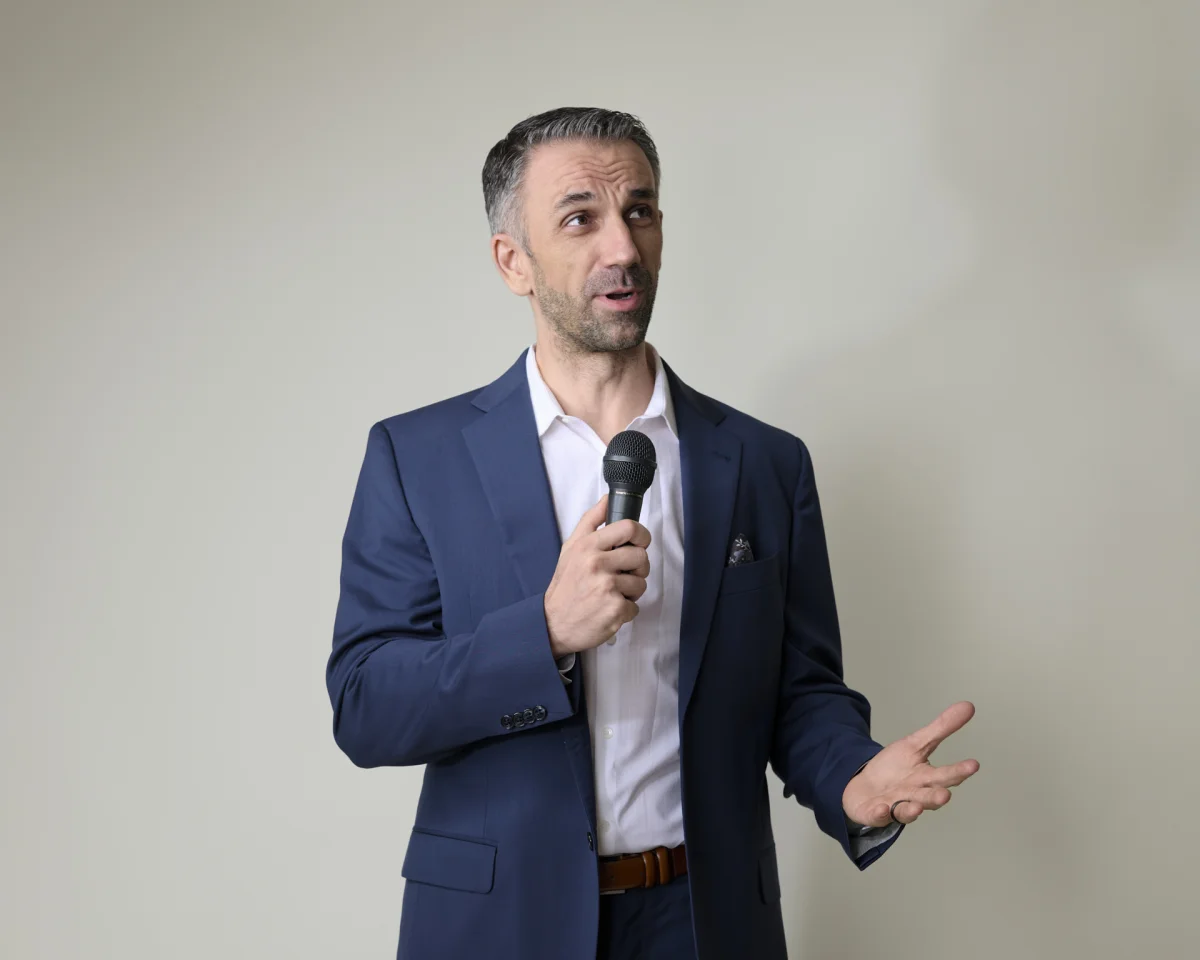
Eight years ago, Serban Mare could barely string two sentences together in front of three coworkers. It was damaging his career. He knew something had to change, so he joined Toastmasters and started the slow, uncomfortable work of learning how to speak. He never imagined that conquering that fear would lead him to want to do it for a living.
(Serban was also Speak Arizona's original cohost, and this is his second visit to the show. Read how the podcast began, or catch his first visit on the 10 mistakes that kill a speech opening.)
But it did. One speech changed everything. Serban felt the power of a message landing in a room and watched it shift how people thought. He wanted to do that on a bigger scale. He wanted to become a paid professional speaker.
So he went all in. He got laid off and decided not to look for another job. Instead, he dedicated nine months to building a speaking business. He signed up for courses, hired coaches, applied to hundreds of podcasts before cracking the code on how to pitch himself. He spent weekends in his office from 5 a.m. to 5 p.m. grinding on outreach, crafting his keynote, and reaching out to anyone who would listen.
It was not enough. The bookings were not coming fast enough to replace a full-time salary. He watched other professional speakers, people he admired, admit they were also struggling to pay their bills. If they could not make it work, how could he?
Serban went back to his corporate job.
"If you asked me six months ago, I would tell you that I felt deeply ashamed and disappointed," he said. "For nine months I was telling everybody that I'm becoming a professional speaker. The reality of going back to work felt like it said about me that I'm a complete failure."
(Rose Swearingen knows that feeling too. Read what happens when you're ready and the answer is still no.)
But something unexpected happened. The seeds he had planted during those nine months started to grow. The conversations, the networking, the content, the visibility, all of it began to compound. Serban started getting booked. He traveled to New York. He spoke in Las Vegas. He delivered keynotes locally. The hard work was finally paying off, just not on his timeline.
Then it stopped again.
"Last week, everything dried up," he told host Rupesh Parbhoo during the recording. "I have two speaking engagements for the next six months. That's it. I was riding this high and now I'm plummeting."
What went wrong was simple. While Serban was busy traveling and speaking, he stopped doing the things that got him there. He stopped reaching out. He stopped applying to events. He stopped being consistent with outreach. The pipeline dried up because he let the systems go.
"We cannot rely on motivation," he said. "We have to rely on systems. You cannot get buff in the gym by going on a Saturday and working out for 12 hours. The way you do it is by going Monday, Tuesday, Wednesday and working out for 30 minutes."
That gym analogy captures the central lesson of his journey. The speaking gigs did not come from one burst of effort. They came from months of consistent, unglamorous work that paid off long after the work was done. And when he stopped doing the work because things were going well, the results disappeared.
Serban now speaks on building resilience and sustaining performance without burning out. His angle is different from most burnout speakers because he is not speaking from the sidelines. He went back to corporate. He is in the trenches with the people who stay up too late finishing projects, who answer emails at midnight, who do not know how to set boundaries. He sees it every day, and that gives his message a weight that a speaker who left the corporate world years ago cannot match.
"Unlike all the other burnout speakers out there, they've experienced burnout at one point and now they're speaking about it, but they're no longer in the trenches," he said. "I went back to work. I'm there with the people who are burning out."
The conversation kept circling back to comparison. Serban talked about how easy it is to look at someone else's year twenty and feel crushed because you are in year three. But he reframed it. Comparison is only poisonous if you use it to beat yourself up. If you use it to learn, to ask what they did to get to the next step, it becomes fuel.
He also shared a moment from his birthday dinner in Jerome, where his wife wrote him a card that said it is all the ordinary moments in life that make a life extraordinary. That idea stuck with him. The late nights grinding on outreach, the awkward early speeches, the shame of going back to work, those are the ordinary moments. And stacked together, they are building something.
"The only way my speaking business is going to fail is if I stop," Serban said. "And if I don't stop, it will succeed. I just don't know in what form and in what timeline."
About Serban Mare
Serban Mare is a professional speaker, program manager in the semiconductor industry, and communication enthusiast. He speaks on building resilience and sustaining high performance without burning out. A Toastmasters member who went from being unable to speak in front of three people to delivering paid keynotes across the country, Serban brings a perspective grounded in lived experience.
Connect with Serban:
- LinkedIn: Serban Mare
- Website: serbanmare.com
Listen to the Full Episode
Catch the full conversation on your favorite platform:
New episodes drop every week. Subscribe so you never miss a courageous conversation.
Learn more about the Speak Arizona team →
Speak Arizona is powered by District 3 Toastmasters, serving Arizona, southern New Mexico, and West Texas. New to all this? Learn how to get better at public speaking and find a club near you.