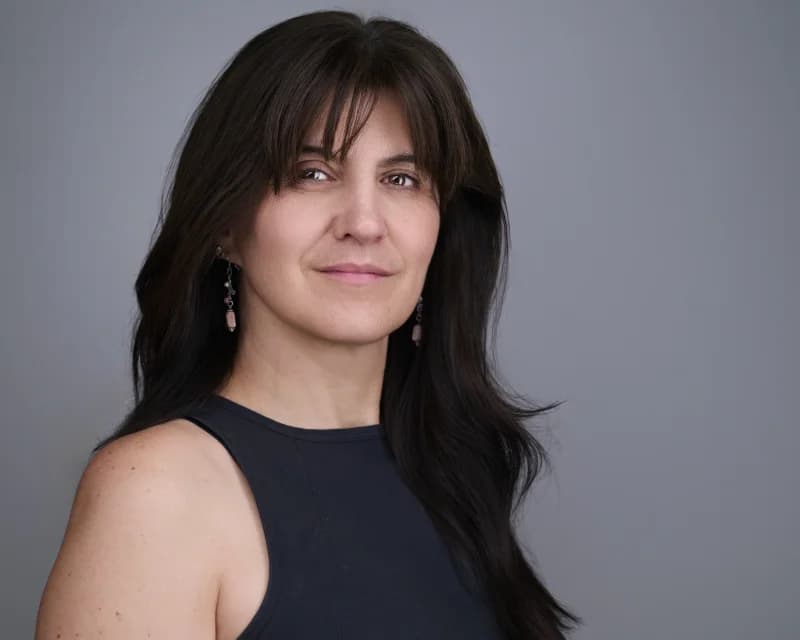
There's a moment that anyone who has learned a second language knows. You open your mouth. You say the thing you've been building in your head. And the person across from you stares back with nothing. No recognition. No understanding. Just blank eyes and the unspoken question: what did you say?
Marie Feutrier lived that moment over and over again.
Marie grew up in France, near the Italian border. She studied theater arts, worked in marketing, earned a master's in organizational management, and built a career across engineering, construction, and information technology. She also happens to be the Webmaster for Speak Arizona, Past President of Gilbert Toastmasters, and the founder of Headshots by Marie, a professional photography business in the Phoenix metro area.
But before any of that, she was a 35-year-old woman who had just moved to the United States and couldn't speak English.
On this episode of Speak Arizona, Marie sat down with host Rupesh Parbhoo to talk about what it really feels like to not be understood, how language shapes confidence, and why learning to communicate in a second language is one of the most vulnerable things a person can do.
From France to Japan to Arizona
Marie's path to the US wasn't a straight line. She was living in France with her husband Vincent and starting a family when a major layoff hit his company. They took the severance package and resigned. Two weeks later, the American branch of Vincent's company called and asked if he was interested in relocating. They said yes before they even knew where they were going.
They ended up in Japan for three and a half years. Marie picked up enough Japanese to get by. One of her proudest moments was walking into the phone company, not knowing the word for contract, and canceling her plan using hand signals and two Japanese words. It worked. She walked out feeling like she had conquered something.
After Japan, they had two choices. Go back to France or spend a few years in America. They chose Arizona. That was 2008. They never left.
The Anger Nobody Talks About
When Marie arrived in the US, she could read English. She could follow what was happening on television. But she couldn't have a conversation. And nobody warned her about what that would feel like emotionally.
It wasn't sadness. It was anger.
Every time she tried to express herself and could see in the other person's face that they didn't understand, frustration would build. Not mild frustration. Something closer to fury. She later learned that children with small vocabularies tend to be more aggressive and she connected with that immediately. It's the same mechanism. When you can't get what's inside your head out into the world, anger is what fills the space.
As a stay-at-home mom at the time, she didn't have many opportunities to practice. She wasn't in an office surrounded by English speakers all day. The isolation made the gap wider. There's not a lot going on when you don't master the language, she says. And that lack of connection made everything harder.
The Networking Group That Broke Her
Marie is a photographer by trade, and she signed up with a networking group to build her business. Every week, each member had to stand up and deliver a one-minute commercial. One minute to explain who you are and why someone should refer you.
Marie knew what she wanted to say. But the moment she stood up and saw the eyes in the room, she could tell they weren't following. Anxiety kicked in. Her pitch went up. She started talking faster and faster. No pauses. No breathing. Words pouring out in a rush that nobody could track.
She looked at the room and saw blank faces. Nobody understood a word.
That was the breaking point. She went home that day and said to herself: I need help. She signed up for Toastmasters.
The Club That Changed Everything
Marie visited two clubs but fell in love with Gilbert Toastmasters. From her first meeting, she felt something different. Toastmasters is a place where people who struggle with confidence find each other. There's a feeling of community. A sense of being on a journey together. Different problems, different challenges, but nobody judging. Just a safe place to make mistakes and grow.
At that first meeting, they asked for a volunteer to do table topics, the impromptu speaking portion of the meeting. Marie raised her hand. She didn't wait until she was ready. She didn't sit in the back and observe for a few months. She decided that if she wanted to progress, she had to put herself out there immediately.
Her first year, she never missed a single meeting. She won Most Improved Member. She went on to become club president. (Stefano McGhee, the club's incoming president, talked about that same culture of growth in his episode.)
Being Interrupted and What It Does to Your Self-Worth
As Marie's English improved, she started participating in group conversations. But something kept happening. People would cut her off. They would talk over her. She never got to finish her thought.
At first, she took it personally. They don't want to hear my accent. I'm not deemed to be listened to. Her self-worth took hit after hit. Every interruption confirmed a story she was telling herself: that her voice didn't matter in this language.
Over time, and with the confidence she built through Toastmasters, the story changed. She won best speaker multiple times. She won best evaluator regularly. People could understand her. The accent wasn't the problem it had been. She started to see the interruptions differently. Maybe she was rambling. Maybe she needed to pause, think, and say something sharper rather than jumping in and filling space with words.
What started as a wound became a lesson. Stop. Think about what you want to say. Then say something that brings real value to the conversation. The thing that felt like rejection at 35 became one of her strongest communication principles at 50.
The Invisible Work of Speaking a Second Language
One of the most eye-opening moments in the conversation came when Marie described what actually happens inside her head during an impromptu conversation in English.
First, she has to think of what she wants to say. Then she has to figure out how to express it in English in a way that will be understood. Then she has to deliver it with correct grammar and pronunciation. All of that is happening simultaneously, in real time, while the other person waits for a response.
She says it feels like losing 20 IQ points. Not because she's less intelligent in English. Because the processing load is enormous. Native speakers never think about this. They hear a question and respond. For someone operating in a second language, every conversation is a three-layer problem happening all at once.
Marie also talked about the physical side of language that nobody warns you about. In French, speech is produced from the front of the face. In American English, it lives more in the throat. That difference is ingrained in muscle memory. She can focus on speaking from the throat, but the moment she relaxes into a conversation, her muscles pull everything back to where French lives. It's not just vocabulary. It's your entire body working against decades of habit.
And then there's emphasis. In English, there's no rule for which syllable gets the stress. You just have to hear it and remember. Every new word is a guessing game. Is it secretary or secretary? Veterinary or veterinary? In French, every syllable carries equal weight. In English, getting the emphasis wrong can mean the difference between being understood and getting a blank stare.
Look at You, in Front of Everybody Who Didn't Climb the Mountain
When Rupesh asked Marie what advice she would give to someone who feels embarrassed about learning a second language, her answer was simple. Jump in. Speak like children do. Say the words. Get them wrong. Give yourself grace.
And don't compare yourself to anyone else. Compare yourself to where you were a month ago.
She shared a memory of climbing a mountain with her mother. Marie was exhausted and wanted to stop. Her mom looked at her and said: look at you, in front of everybody who didn't climb the mountain today.
She still thinks about that.
The shame of sounding imperfect, of not being fluent, of losing your train of thought mid-sentence is real. Marie doesn't dismiss it. But she says when the shame comes, you have to break it. Step back. Be rational. Look at where you are. You're on the mountain. Most people never even started the climb.
(Matt Malan made a similar point about rewriting the story you tell yourself about speaking — different starting point, same principle: the work is what you do with the voice in your head.)
About Marie Feutrier
Marie Feutrier is a professional photographer, the Webmaster for Speak Arizona, Past President of Gilbert Toastmasters, and VPE of ProjectMasters Toastmasters. She is the founder of Headshots by Marie, a professional photography business based in the Phoenix metro area.
Connect with Marie:
Listen to the Full Episode
Catch the full conversation on your favorite platform:
New episodes drop every week. Subscribe so you never miss a courageous conversation.
Learn more about the Speak Arizona team →
Speak Arizona is powered by District 3 Toastmasters, serving Arizona, southern New Mexico, and West Texas. New to all this? Learn how to get better at public speaking and find a club near you.