Most speakers lose the room before they finish their first sentence.
Not because they don't know their material. Not because the topic isn't interesting. But because they open with something that tells the audience: you can check out now.
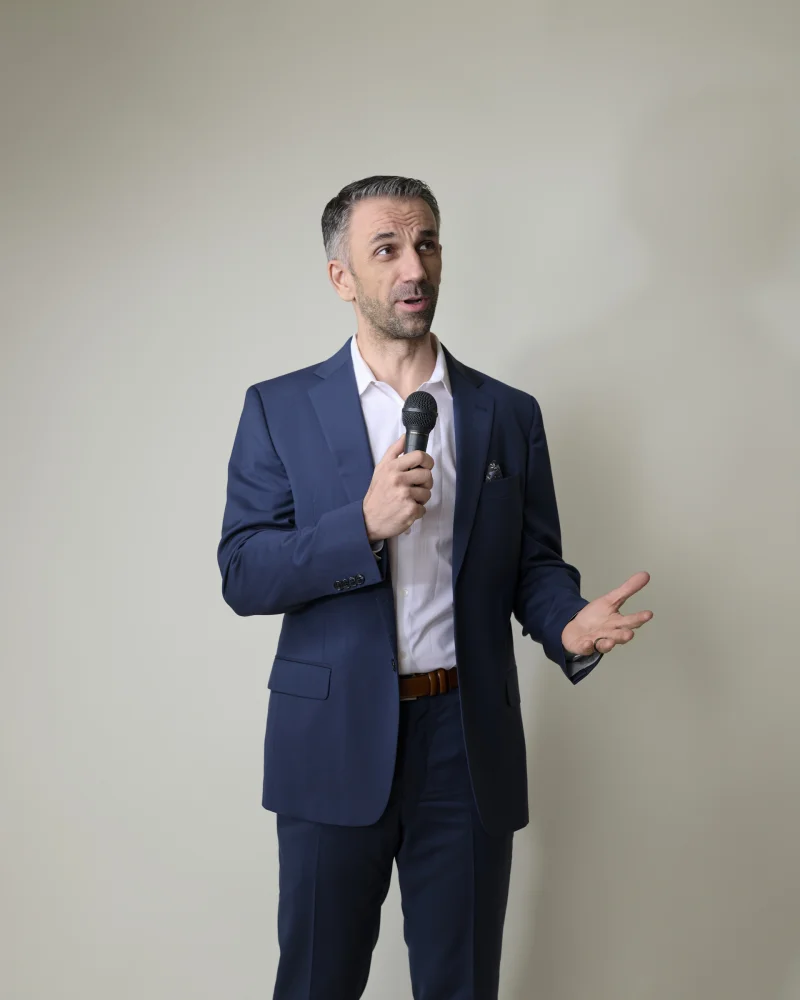
In this episode, host Rupesh Parbhoo brings back Serban Mare — past co-host of Speak Arizona, corporate speaker, and burnout expert — to walk through the ten most common ways speakers sabotage their own openings. They also share three simple alternatives that actually earn attention.
And yes, Serban committed one of these sins on stage at a recent conference. That's what inspired the whole conversation.
The 7-Second Rule for Public Speaking
Before diving into the list, here's the context that makes all of this matter: your audience decides within about seven seconds whether to give you their attention or start thinking about lunch, email, or their phone.
Seven seconds. That's it.
Every opening mistake on this list burns through those seconds without giving the audience a reason to stay. Every alternative makes those seconds count.
10 Ways to Lose Your Audience Before You Start
1. "Hi, my name is..."
If someone just introduced you, your name is already on the slide, or your coworkers already know who you are — reintroducing yourself is redundant. It signals that you don't have anything more interesting to say yet. Skip it and open with something that earns attention.
2. "I'm so nervous."
Every speaker gets nervous. Even Serban, who regularly speaks at corporate events, describes the experience as a duck on calm water — calm on top, legs paddling underneath. The storm inside almost never shows the way you think it does. Announcing your nerves signals to the audience that you're not ready, which makes them uneasy too.
And while they're on the topic: stop apologizing for mistakes mid-speech. Ninety-five percent of the time, your audience didn't even notice. Calling it out just puts the error in their heads. Serban shared a story about Simon Sinek forgetting where he was in a speech — instead of apologizing, he turned it into a vulnerable moment, asked the audience where he left off, and kept going. No apology. Just presence.
3. "Can everybody hear me? Can you see my slides?"
If you're doing a microphone check or a tech check with the audience already seated, you weren't prepared. Professional speakers get there early — sometimes the day before — to test everything. Make friends with the AV team. They're there to make you look great, and they have one of the hardest jobs at any event.
Rupesh pointed out that this applies to virtual presentations too. Zoom and every other meeting platform give you feedback on what's being shared. Learn the tools so you come off polished instead of flustered. Fifteen extra minutes of setup saves you from burning your opening on logistics.
4. "How's everyone doing today?"
It's the most common opener in public speaking, and it's the emptiest. You're making the audience do something — respond — but you're not going to use that response for anything. It's superficial interaction disguised as engagement.
Now, here's where it gets interesting. This is exactly how Serban opened his recent presentation at a SHRM conference in Arizona. But he followed "How's everyone doing?" with "I know I'm standing between you and lunch, so I'm going to make sure I feed you a lot of information." The cliche became the setup for a punchline that actually landed — it loosened the room and signaled they were going to have a good time talking about a heavy topic like burnout.
Rupesh's verdict: he forgives Serban. The lesson isn't that cliches are always bad — it's that you can't stop at the cliche. If you're going to use one, twist it into something clever and connected to your message.
5. Starting with housekeeping instead of your message
Thanking the AV team, the event organizer, reminding people to fill out the survey, congratulating someone on something unrelated — all of this can happen before or after your talk. When you start with housekeeping, your audience's engagement plummets before you've said anything of value. Let whoever introduces you handle logistics. You're there to deliver a message.
6. "I only have 10 minutes, so I'll rush through this."
This one drives Rupesh crazy. If your time got cut, that's your problem to solve — not the audience's burden to absorb. Scale your message to fit the time you have. Know what to cut before you get on stage. And if you're really squeezed, lead with your single key message. The audience should walk away thinking "that person had a lot to say and I want more" — not "they seemed flustered and unprepared."
Both Rupesh and Serban agreed on a universal truth: audiences will always forgive you for ending early. They will never forgive you for going over time.
7. "I didn't have time to prepare."
Close cousin of number six, and equally damaging. Even if it's true — you were asked last minute, your schedule was packed — saying it out loud signals to the audience that you don't value their time enough to have shown up ready. As Rupesh put it, it's the same as apologizing: the audience didn't need to know, and now they're questioning whether this is worth their attention.
The better move? Learn to speak off the cuff. (For more on overcoming speaking fears, check out Matt Malan's story of going from a stutter to the Toastmasters stage.) Know your core message so well that even without full preparation, you can deliver something valuable. That's a skill worth developing whether your speech is prepared or not.
8. Starting with a weak joke that doesn't connect
Serban shared a story about watching a speaker walk on stage and announce, "I'm going to start my presentation with a joke." Red flag. The joke had an okay punchline — but it had absolutely nothing to do with her topic. The audience was left wondering what just happened.
Serban's advice: skip jokes. Use humor instead. There's a difference. A joke is a setup-punchline structure that puts pressure on the laugh. Humor is something light and natural — like the "I'll feed you information" line — that doesn't need a rim shot to work.
Rupesh added a bigger point: even if your hook is impressive, it has to connect to your message. He described a major tech conference that opened with gymnasts doing acrobatics from the ceiling. It was visually stunning — but the keynote speaker never referenced it. The most expensive opening in the room, and it connected to nothing. Cool doesn't equal effective.
9. Opening with a confusing or negative question
Serban owned up to this one too. At a conference, he walked on stage and enthusiastically asked, "Who's ready to talk about burnout?" Nobody is ready to talk about burnout. The energy was completely mismatched for the subject.
He also described watching a speaker open with a rambling question about floppy discs that left the entire room confused. The lesson: don't create confusion early. Confusion makes people check out, and it's very hard to get them back.
His fix was simple and elegant. Instead of "Who here is burned out?", he now asks, "Has anyone here known someone who has dealt with burnout?" It shifts the question from personal admission to shared experience. Suddenly everyone can raise their hand without feeling exposed.
Rupesh built on this with a broader rule: if you ask the audience a question, do something with the answer. Acknowledge it, reference it, build on it. There's nothing cheaper than asking for a show of hands and then ignoring the result.
10. Over-explaining your background before your message
The final mistake is the rambling preamble — explaining your title, your credentials, how you got invited, why you changed your slides from last week. Nobody needs to know that your presentation was originally for a different company or that you tweaked two slides this morning. It's the public speaking equivalent of showing someone your rough draft before they've asked to read the final version.
3 Speech Openings That Actually Work
1. Start with a compelling fact or statistic
Serban opens his burnout keynote with: "66% of professionals report moderate to severe levels of burnout. That means more than half of us here have felt the effects."
Numbers are tangible. They're proof. And when paired with a question or show of hands, they create instant engagement because the audience just saw the statistic reflected in the room.
2. Ask a simple question that gets a yes
Serban's go-to: "Do you know someone who's been tired or burned out in the last six to nine months?" Nearly every hand goes up. Then: "How many of you would like to have more energy, more joy, and more focus in your day-to-day?" It's almost a silly question — of course they do — but it gets the audience leaning in and saying yes.
The key is to make the question relevant to your topic and easy to answer. Don't ask people to admit something vulnerable in front of a crowd. Ask something they can agree with comfortably.
3. Open with a personal story
Serban's example: "I came to the United States with $200 in my pocket and a lot of drive and ambition to attain the American dream." Immediately, you want to know more. Where did he come from? What happened next?
Rupesh added a crucial refinement: start in the action, not in the context. Don't build up to the interesting part — open with it. Think about what makes the best movie openings work. They drop you into the middle of something and let you catch up.
And for professionals who think personal stories are "too casual" for corporate settings: Rupesh pushes back on that hard. He's coached speakers who resist using personal anecdotes in technical presentations, and every single time they do it, it lands. Personal stories create connection, and connection creates attention.
The Power of the Pause Before You Speak
Serban shared a final tip that ties everything together. Before you say your first word, just pause. Take a breath. Look at the audience.
A professional speaker coached him on this before a big presentation: look at the room, breathe in, and remind yourself that you have something meaningful to share. When he did it, his shoulders dropped, he relaxed, and his opening landed with a different kind of weight.
Rupesh loves this technique too. That opening silence feels counterintuitive — won't people think something's wrong? — but the opposite happens. The audience leans in. Quiet draws attention in a way that rushing to fill the silence never does.
How to Nail Your Speech Opening Every Time
Memorize your first two to three sentences. Memorize your last two to three sentences. If you have those locked in and you can deliver them with confidence, you can navigate the middle. But burn those opening seconds on apologies, cliches, or tech checks, and you'll spend the rest of your time trying to win back an audience that already checked out.
As Serban put it: stop opening with politeness. Open with presence.
About Serban Mare
Serban Mare is a PMP-certified Technical Program Manager with 20 years of experience in the semiconductor industry, leading complex mixed-signal IC projects from concept to mass production. He's also a corporate speaker specializing in stress resilience, energy management, and workplace well-being — and a past co-host of Speak Arizona.
Connect with Serban:
- LinkedIn: Serban Mare
- Website: serbanmare.com
Listen to the Full Episode
Catch the full conversation on your favorite platform:
New episodes drop every week. Subscribe so you never miss a courageous conversation.
Learn more about the Speak Arizona team →
Speak Arizona is powered by District 3 Toastmasters, serving Arizona, southern New Mexico, and West Texas. New to all this? Learn how to get better at public speaking and find a club near you.