What happens when the story you've told yourself for 15 years is "I can't speak" — and you decide to rewrite it?
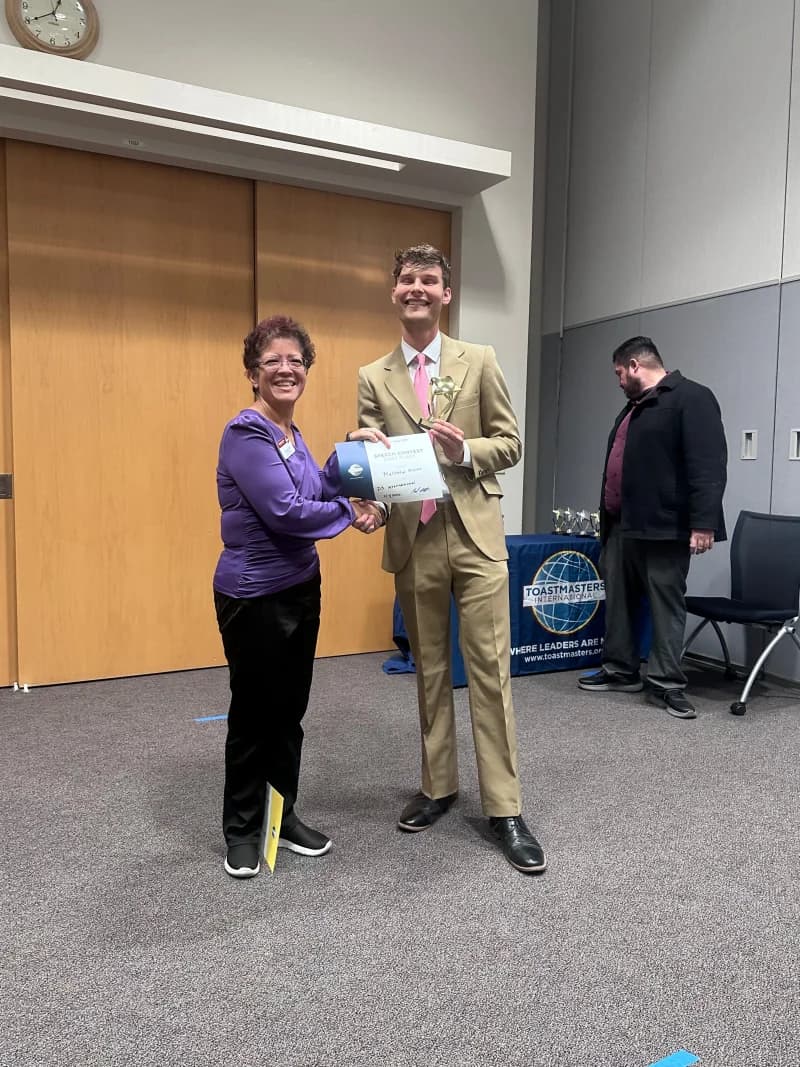
In this episode, host Rupesh Parbhoo sits down with Matt Malan, a fellow member of Dobson Ranch Toastmasters, to talk about one of the most honest transformations we've featured on the podcast. Matt went from a childhood stutter and years of silence to competing in the Toastmasters International Speech Contest — and the journey between those two points is anything but a straight line.
How a Second Grade Presentation Created 15 Years of Silence
Matt's story starts in Miss Sylvia's second grade class. He got up to give a presentation. He couldn't get the words out. The kids laughed. He cried. He sat back down.
And for the next 15 years, he carried a single belief: I can't speak to people.
Matt had a severe stutter from age six to eighteen. He went through ten years of daily speech therapy — an hour a day at school. By high school, he'd gone almost completely silent. From sixteen to eighteen, he barely spoke to anyone. He eventually switched to homeschool to avoid people altogether.
That's where the story could have ended. But it didn't.
Why Your Brain Collects Evidence Against You
One of the most powerful ideas Matt shared is something Rupesh immediately latched onto: if you believe something about yourself, your brain will find ways to prove you right.
Every stumble on stage. Every awkward pause. Every moment where the words didn't come out the way he wanted — Matt's brain filed it all as proof that he couldn't speak. Twenty years of "evidence" stacked against him.
The problem isn't the individual failures. It's the lens you're looking through when they happen. Two people can go through the exact same experience — one sees a learning moment, the other sees confirmation that they're broken. Matt spent years in the second camp.
Rupesh connected this to a story from his yoga instructor: two people riding the same escalator into a mall food court. One sees couples smiling and families celebrating. The other notices a closed store and a person sitting alone. Same scene, completely different experience — filtered through whatever you're carrying with you that day.
The takeaway? You don't just need to change what you do. You need to change what you see.
From "I Can't Speak" to "I'm Learning" — Rewriting Limiting Beliefs
Matt describes the shift in his self-talk as the difference between black magic and white magic.
Black magic is the language that controls you. Words like "I can't," "impossible," "never." White magic is the language that frees you. Words like "I'm learning," "next time," "what can I try differently?"
He used to see a rough speech as proof he'd never be a speaker. Now he sees it as data. What went wrong? Talk slower. Try a different story. Adjust the pacing. The outcome might look the same on the surface — a speech that didn't land — but the internal experience is completely different.
One is a dead end. The other is a direction.
Matt calls out black-or-white thinking as especially dangerous when you're learning a new skill. You can't go from zero to perfect. You have to take baby steps. And you have to let those steps count as progress — even when they're small.
How to Track Your Beliefs with a Spreadsheet
Here's where Matt's approach gets practical — and unexpectedly nerdy.
He keeps a spreadsheet. Not just for goals or habits, but for his actual belief systems. He writes down his limiting beliefs, scores them on a scale of one to ten, rewrites them into something productive, and tracks his progress over time. (Anna Barnhill calls this your internal operating system — the invisible code that drives how you think, feel, and lead.)
So instead of "I can't make friends," he writes "I'm open to connection." Then every time he has a positive interaction — a conversation that went well, a joke that landed, a moment of genuine connection — he logs it. The number goes up by 0.1. Small gains. But gains that compound.
The logic is simple: feelings lie. Numbers don't. When your inner voice says "you're a loser," a spreadsheet full of data points says otherwise. And when you frame growth as going from a seven to an eight on a specific skill, you're in problem-solving mode — not, as Matt puts it, "pity party mode."
Rupesh loved that framing so much he threatened to trademark it.
The Toastmasters Mentor Who Wouldn't Stop Emailing
Matt credits a lot of his transformation to one person: Don Ratliff.
Matt had been showing up to Toastmasters inconsistently for three years — two weeks on, months off, repeat. Then Don got his email and started reaching out. And reaching out. And reaching out again.
Matt's first thought after seven emails? Dude, chill. His second thought? He actually cares.
Don saw something in Matt after watching him speak just once. He invited Matt to his house to practice speeches — the same speech, over and over, a dozen times. It wasn't glamorous work. But it was the price of growth.
What made the difference wasn't just Don's coaching. It was the fact that someone believed in Matt before Matt believed in himself. That shifted everything. Before Don, showing up to meetings was entirely on Matt's shoulders, and the pressure made it easy to quit. Having someone in his corner — someone rooting for him — made the hard thing feel possible.
Rupesh connected this to a broader point — one that Rachel Perez also explored in her episode on networking: coaches and mentors matter, but so does being coachable. You have to be willing to show your rough edges, accept feedback, and do the unglamorous reps. Practicing a speech is an exercise in vulnerability. You have to let people see the version that isn't polished yet.
What If Your Stutter Was a Gift?
The emotional core of this episode comes from a phone call Matt made to his dad during his two-year mission trip for his church.
Matt had gone from being almost completely silent to suddenly knocking on doors and talking to strangers every day. The first six months were brutal — constant anxiety, freezing weather, and the relentless pressure of trying to do the one thing he'd spent his whole life avoiding.
Then came the rock-bottom moment. Someone asked him his name. He tried to say "Matthew." He couldn't get it out.
He called his dad and told him he wanted to come home. His dad's response changed everything: What if your stutter was a gift? What if it gave you the skills and hunger you need to become great?
Matt realized something most people never think about. Other kids could just talk. He had to spend an hour rehearsing a single sentence — working on tonality, pacing, tricks to avoid stuttering. That forced repetition built a skill most people never develop: the ability to work relentlessly hard at communication.
The curse became the engine.
Matt's message to listeners: the things you hide from people — whether it's a stutter, anxiety, depression, or some other part of yourself you're ashamed of — might actually be your greatest gifts. Not because the pain is fun, but because the work you do to overcome it builds something in you that nothing else can.
Small Gains: The Trash Can Approach to Public Speaking
Rupesh and Matt landed on a shared metaphor that ties the whole episode together: progress happens in small increments, not giant leaps.
Rupesh shared a story from his marathon training days, running on the beach in Los Angeles. During a 22-mile training run, he didn't think about the full distance. He just looked for the next trash can — about 50 yards ahead. Get there. Then find the next one.
He compared it to holding triangle pose in hot yoga — a grueling posture held for one minute in a 105-degree room. You don't think about the full minute. You think about the next ten seconds.
Matt connected it right back to public speaking: you don't think about being a great speaker in ten years. You think about the next meeting. The next speech. The next rep.
And both of them agreed on something just as important — don't forget to look back. When you're grinding through trash can after trash can, it's easy to lose sight of how far you've come. Celebrate that distance. You earned it.
Public Speaking Advice: Don't Be Afraid to Look Stupid
Matt's advice for new speakers is the same advice he wishes he'd given himself in second grade: don't be afraid to look stupid.
He's bombed speeches. Plenty of them. But every bomb was a rep, and every rep made the next one a little less scary. If you're protecting a reputation or trying to look cool, you're going to miss the chances to practice and grow.
Rupesh saw this firsthand. He remembers the first time Matt actually showed up and gave a speech — after missing his original slot out of fear. There was something magnetic about watching someone face the thing that terrified them. No polish. No pretense. Just a person standing up and trying.
That authenticity is what made Rupesh reach out afterward and eventually invite Matt on the podcast. Not because Matt was a perfect speaker — but because his willingness to be imperfect was the most compelling thing in the room.
Work for 80-Year-Old You
Matt's parting thought was simple and stuck with both of them: work for future you.
He pictures 80-year-old Matt and asks himself whether the choices he's making today are setting that guy up for success or letting him down. Every rep you skip, every hard thing you avoid — future you feels that.
But — and this is the balance — don't get lost staring at the horizon. Stay present. Take it one trash can at a time. Celebrate the wins. And trust that the small gains add up to something 80-year-old you will be proud of.
About Matt Malan
Matt Malan is a member of Dobson Ranch Toastmasters and a Toastmasters International Speech Contest competitor. He works in sales, marketing, and operations for a family business, and he's currently training for his first marathon. He went from barely being able to say his own name to competing on the Toastmasters International stage — all within a matter of months.
Connect with Matt:
- LinkedIn: Matt Malan
Listen to the Full Episode
Catch the full conversation on your favorite platform:
New episodes drop every week. Subscribe so you never miss a courageous conversation.
Learn more about the Speak Arizona team →
Speak Arizona is powered by District 3 Toastmasters, serving Arizona, southern New Mexico, and West Texas. New to all this? Learn how to get better at public speaking and find a club near you.