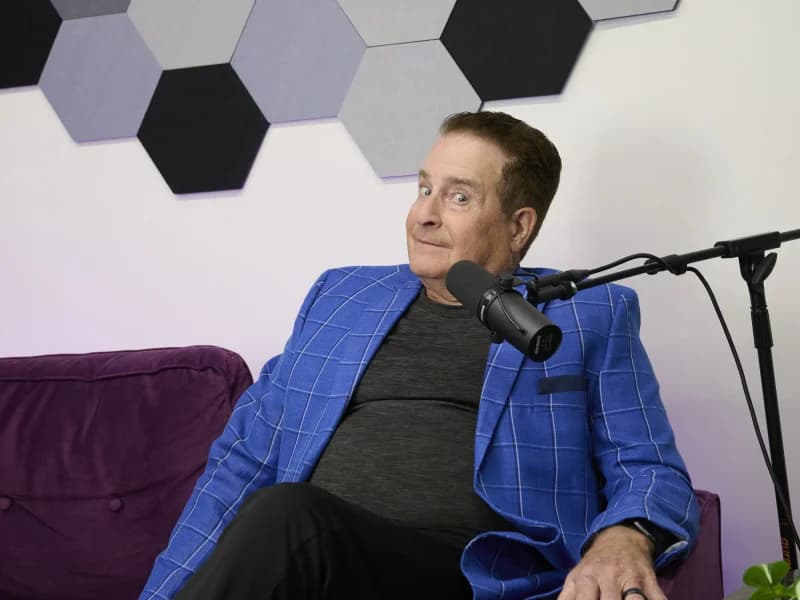
Paul Pastore walks into a Toastmasters meeting and within minutes someone is laughing. It looks effortless. It feels natural. And if you assumed he was just born that way, he would be the first to correct you.
Paul has been part of Toastmasters since 1976, nearly 50 years of showing up, speaking, mentoring, and pushing the people around him to be better. He is one of those rare members who stays not because he has to, but because he genuinely cares. About the craft. About the people. About getting things right.
In this episode of Speak Arizona, host Rupesh Parbhoo sits down with Paul for a conversation that covers how humor is actually built, what keeps someone engaged in an organization for decades, and what one small disagreement between the two of them taught Rupesh about leading change well. It is funny, honest, and surprisingly deep.
Humor Is a Skill. Treat It Like One.
The most important thing Paul says in this entire conversation comes early, and it reframes everything that follows.
"People want to be entertained more than they want to be informed. You really have to buy into that."
Most speakers get this backwards. They prepare their content, load up their slides, and then wonder why the audience checked out by slide three. Paul has spent decades watching this happen, and his solution is not a personality overhaul. It is a skill you practice.
Rupesh admits openly that he has always believed he is not naturally funny. Paul's response is not reassurance. It is a system.
Find a joke that makes you laugh on YouTube or a Facebook reel. Write it on a three by five card or save it on your phone. Memorize three jokes. Ask a friend to remind you of the funniest story you have ever told. Then practice telling it with the right pauses, the right emotion, the right timing.
"It's just like Toastmasters," Paul says. "How many people come in and say I can't speak in public, I've always been shy? It's a skill. And a subset of that skill is humor."
That reframe is the gift of this conversation. You are not either funny or not funny. You are either building the skill or you are not. It is the same mindset that improv performers use to connect with audiences on the fly.
Two Rules for Telling a Joke That Lands
Once you have decided to build the skill, Paul has two non-negotiable rules.
First: never read a joke off your phone. Ever. The moment you look down at a screen to deliver a punchline, the joke is already dead. The whole point of humor in a speech is spontaneity and connection. Reading kills both, just like reading your opening off a script kills your first impression.
Second: never tell a long joke. Attention spans are short. People are already half somewhere else in their heads. A joke that takes two minutes to set up is not a joke. It is a gamble you will almost certainly lose.
"The cat joke I told," Paul says, referring to the Walmart gag he opened the episode with, "I bet that was 30 or 45 seconds. No long jokes. And don't read the joke."
He also shares a framework for measuring whether your humor is actually working: count the laughs. Not just whether people laughed, but how many times, and how big. Paul asks his evaluators to track big laughs, medium laughs, and small laughs in every speech. He learned this from professional speaker Joel Weldon, who once told him at an area contest that you need at least 12 laughs to win. It sounds analytical for a topic that feels so intuitive, and that is exactly the point. If you can count it, you can improve it.
What Keeps Someone Coming Back for 50 Years
Rupesh raises something that every Toastmasters leader quietly worries about: most members join, stick around for six months, and disappear. The people who stay for years, let alone decades, are genuinely rare. So what keeps Paul coming back?
Part of it is the people. Part of it is the fun. But the deeper answer is that Paul has always had a goal, and when one goal was complete, he found the next one.
"Initially your goal will be to complete a path. Then it's to get in a speech contest. Iron sharpens iron."
He draws a parallel to his career in real estate, where designations and long term credentials kept him growing and engaged for 40 plus years. In Toastmasters, the equivalent is the DTM, the Distinguished Toastmaster designation, which Paul describes as a PhD in public speaking. The people who stay are the ones who keep setting the next target.
But Paul's longevity is not just about his own goals. It is about what he gives back. After every single meeting, without fail, he makes his way around the room. He finds every speaker and tells them they did a good job. He finds the evaluators. He finds the winners of table topics. And when he spots a brand new member, he has a specific routine ready: explaining what FORD stands for, family, occupation, recreation, dreams, and telling them to start preparing their icebreaker speech now because it will be here before they know it.
"You'd be surprised how many people don't do that," he says simply.
It is the same quiet power that Matt Malan describes when he talks about the people who believed in him before he believed in himself. Mentorship without the formal title. Encouragement without the agenda. And it costs him almost nothing except the intention to do it every time.
Kaizen or Entropy. Your Choice.
One of the most unexpected moments in this conversation comes when Paul is explaining why he gives so much feedback to Rupesh and the club leadership.
"The concept of entropy is everything is breaking down. So unless you are into continuous improvement, which is kaizen, you're going to be in kaizen or you're going to be into entropy. That's your choice."
It is a simple binary, and it applies to everything. Organizations. Skills. Relationships. Public speaking clubs. If you are not actively improving, you are not standing still. You are declining. The only question is which direction you choose to move in.
For Paul, giving weekly feedback to club officers is not a compulsion or a criticism. It is kaizen in practice. A small, consistent investment in the direction of better.
What One Disagreement Taught Rupesh About Leading Change
The most personal part of this episode is also the most instructive. Rupesh walks through a change he introduced at Dobson Ranch Toastmasters: replacing paper ballots for in-meeting voting with a QR code system. It was a genuine improvement in efficiency. It was also met with resistance, including from Paul, who continued using paper ballots for a while before eventually coming around.
Paul is characteristically direct about it. "I don't think you need notes for your icebreaker. You remember your family. You know what you do for a living. You know what you do for fun." He applies the same logic to change: if something genuinely works better, people will figure that out over time. But you cannot rush the timeline.
Rupesh's honest reflection is the real takeaway here.
"The change is not instant and it takes time for things to be adopted. Don't expect overnight results if you have made a change. Pay attention. If people hate it, that is something you need to know. But it does not happen overnight. And don't take those noisemakers, that feedback, personally."
It is a lesson that applies far beyond Toastmasters. Whether you are introducing a new process at work, leading a team through a transition, or just trying something different in your presentations, the resistance you hear in the first few weeks is not the final verdict. Give it a runway. Stay curious. And separate the noise from the signal.
Stand Up, Speak Up, Shut Up, Sit Down
Near the end of the conversation, Rupesh asks Paul about the biggest trap speakers fall into. His answer is quick.
"Talking about yourself too much. There is a balance between the word I and the word you."
The best speeches are not about the speaker. They are about the audience. It is a lesson Bianca Riemer echoes when she talks about why technical experts lose credibility in the boardroom. The stories, the humor, the insights, all of it should ultimately connect back to something the person in the seat can take with them.
Paul distills his entire philosophy of speaking into four words: "Stand up, speak up, shut up, sit down."
And when Rupesh asks for his single piece of advice for a new public speaker, Paul delivers it without missing a beat.
"Always check your zipper before you start speaking. Because if everybody is looking low, there's a zipper problem."
The episode ends exactly where it started: with a laugh.
About Paul Pastore
Paul Pastore has been a Toastmasters member since 1976 and holds the Distinguished Toastmaster (DTM) designation. With a 40-plus year career in real estate and nearly five decades of public speaking, he brings a rare combination of humor, directness, and genuine care to every room he walks into.
Want to connect with Paul? Google him. His words, not ours.
Listen to the Full Episode
Catch the full conversation on your favorite platform:
New episodes drop every week. Subscribe so you never miss a courageous conversation.
Learn more about the Speak Arizona team →
Speak Arizona is powered by District 3 Toastmasters, serving Arizona, New Mexico, and West Texas.